Celestial harmoniesDevotional ritual of the Ahl-e Haqq (Jam-e Zekr), a special mix of music, song and poetry.scrollA devotional ceremony that goes back thousands of yearsTraditional dancesKurdish ethnic dances in colorful festive costumes accompanied by lively musicscrollDance repertoiresPolyrhythmic compositionsVirtuoso dialogues of the Kurdish frame drums (daf ).scrollPercussion MedleyTraditional musicKurdish ethnic music in festive melodies, authentic maqams and chants.scrollThousands of years of musical traditionAbout Us
The Razbar ensemble was founded in 1997 by a group of Kurdish men and women from Iran living in Germany. Without any political or nationalist intentions, their objective was to preserve and revive the music, songs and traditions of the Ahl-e Haqq.
The group takes its name from Saint Razbar, mother of Soltan Sahâk, the founder of this path 700 years ago. All members of the group are deeply connected to this tradition. They consider their songs, melodies, rhythms and dances to be a form of devotion into which they pour their heart and soul. Moreover, the musicians of this group have a high professional qualification acquired in their environment of origin.
Our activities
The Razbar ensemble’s main purpose is to present and preserve an ancient musical heritage that is rooted in a strong cultural and spiritual tradition but is at risk of extinction or acculturation.
The heritage that Razbar intends to preserve, revitalize and share with the public, presents itself in two aspects: the profane and the sacral. However these categories are not strictly seperated but sometimes merge into one another. Razbar’s program consists of folkloric dances and polyrhythmic compositions for percussion instruments (daf) on the one hand, and sacral vocal and instrumental music, performed either within or outside of its ritual context, on the other.
Razbar gained its global reputation through the beauty and power of its sacral songs and litanies (zekr and samâ). In order to present the secular aspect of Kurdish culture, Razbar has also worked on a repertoire of festive melodies and dances. Depending on the requirements of concert organizations, Razbar can provide the following:
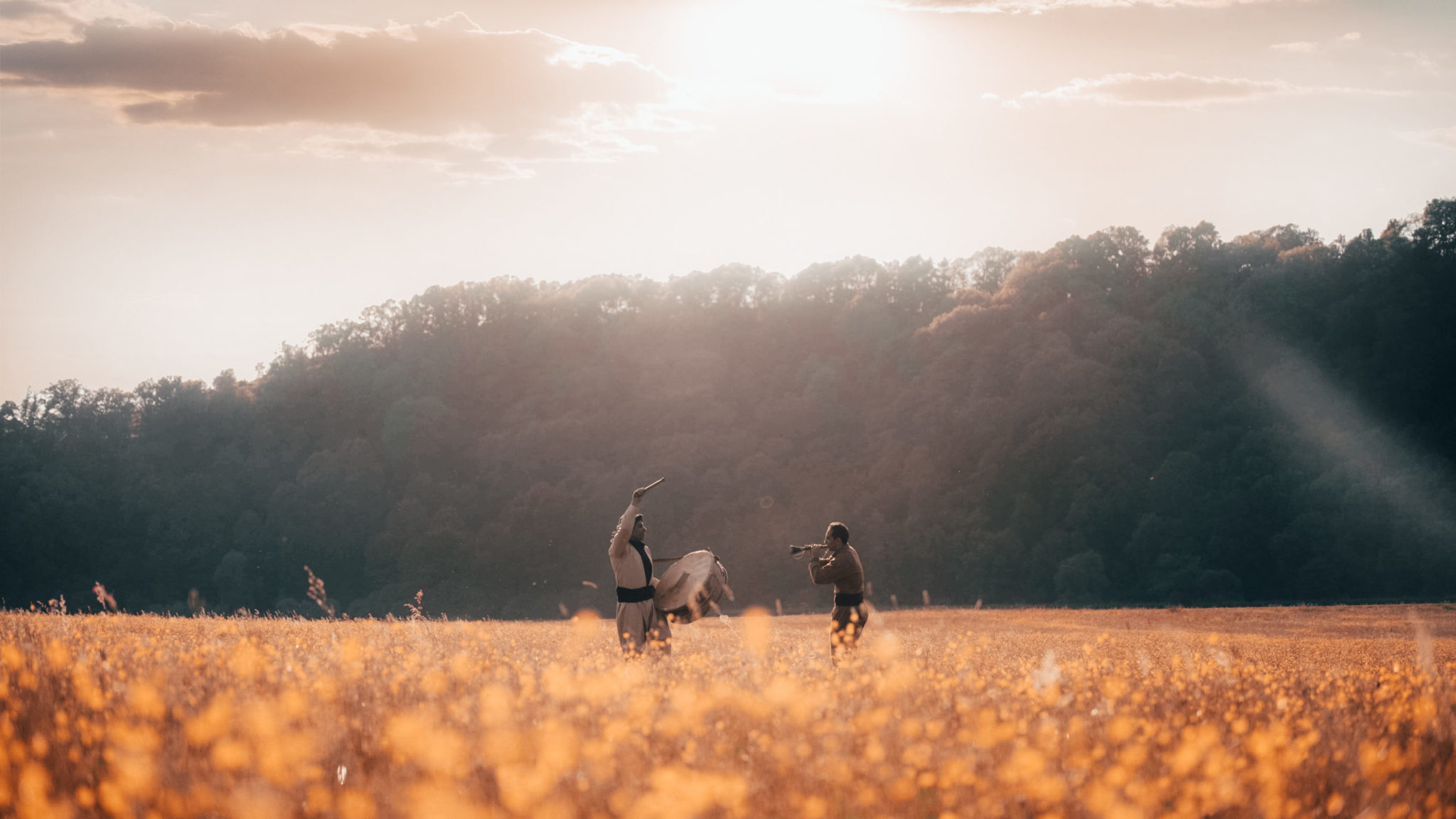
Celestial harmoniesTraditional musicPolyrhythmic compositionsTraditional dancesCelestial harmoniesThe devotional ritual “Jam“ is specific to the Ahl-e Haqq. It unites a dozen or more men and women and includes meditative parts, chants and hymns accompanied by instruments, as well as dance melodies. Its course is not strictly defined and allows for large sections of improvisation.Traditional musicThese same pieces may also be presented in the context of a spiritual musical program that is limited to a few instrumentalists and a single vocalist.Polyrhythmic compositionsPercussion instruments (daf) form the intersection between spiritual and profane music. Razbar has created an impressive rhythmic ensemble that unites six or more daf players who perform with great virtuosity, in unison or in reciprocal dialogue.Traditional dancesAnother delightful show comprises a dozen men and women dressed in marvelous attire who dance together or individually to the sound of the oboe (sornâ) and percussion."The Razbar group is commendable for its remarkable efforts to present and preserve the rituals and traditions of the Ahl-e Haqq order, which have been passed down from generation to generation mainly through a collection of music and sacred texts."Islamic scholar and professor of comparative religion, philosophy and theology at Boston CollegeProf. James Morris"Not only is the public fascinated by the spectacular and emotional aspect of the Razbar group’s music and ritual dances, but they understand that this is a unique opportunity. With the Razbar ensemble, you discover an original and authentic musical culture that has remained discreetly hidden for centuries."Ethnomusicologist, orientalist at the French National Center for Scientific ResearchProf. Jean During "I have come to know the ensemble quite well, and have been profoundly touched and deeply enthralled by the spiritual power of their music. Their music has an astounding effect on the audience, drawing listeners into uncharted territories of rapture and elation. I wholeheartedly wish the Razbar ensemble great success in their tireless efforts to pave the way for bringing Western cultures one step closer to Eastern philosophies and spirituality."Professor emerita of Indo-Muslim
Culture at Harvard UniversityProf. Annemarie Schimmel( † 26 January 2003 )
To change your privacy setting, e.g. granting or withdrawing consent, click here:
Settings